

Never again will you be capable of ordinary human feeling. Everything will be dead inside you. Never again will you be capable of love, or friendship, or joy of living, or laughter, or curiosity, or courage, or integrity. You will be hollow. We shall squeeze you empty and then we shall fill you with ourselves.—
This is what happens, perhaps, when you lose your right to read and think what you want.
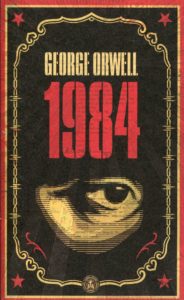 Big Brother, Newspeak, Doublethink—words that are now part of our everyday language—are words that George Orwell coined in 1984, his dystopian novel warning about the oppression of a totalitarian state, a “.� Last week marked the seventieth anniversary of the publication of that novel that still has meaning today.
Warnings aside, this book that paints the dangers of censorship has been banned:
-  in 2018 in when it was used in media discussions of the new constitutional amendment to end term limits for Chinese president Xi Jinping.
- in the USSR for being anti-communist,
- in 2008 in Jackson County, Florida, for being “procommunist,� and
- in 2017 at Rigby High School in Idaho, by whether one passage of the book aligned with community goals, ideals, and institutions.�
, 1984 made the .
As a ,
Orwell’s book was not intended as a book about life under Communism. It was intended as a warning about tendencies within liberal democracies, and that is how it has been read. The postwar Sovietization of Eastern Europe produced societies right out of Orwell’s pages, but American readers responded to 1984 as a book about loyalty oaths and McCarthyism. In the nineteen-seventies, it was used to comment on Nixon and Watergate. There was a bounce in readership in 1983-84—four million copies were sold that year—because, well, it was 1984. And in 2016 it got a bump from Trump.
Certainly, despite objections, the text has managed to live for these 70 years. Â¥·ïÌìÌà even gives out awards based on Orwell’s writing:
- an ironic tribute to public speakers who have perpetuated language that is grossly deceptive, evasive, euphemistic, confusing, or self-centered.
Watch this brief primer on the book:
Or listen to
Refer to the following blogs that focus on the right to think, write, and read:
“â€�Â
“.�